How to Source Bulk Ceramic Mugs from Reliable Suppliers?
Sourcing Bulk Ceramic Mugs is not simply a price comparison exercise. It is a quality, capacity, and risk decision. Global demand for ceramic tableware remains strong, supported by cafés, hotels, corporate gifting, and online retail. Grand View Research identifies the ceramic tableware market as a growing global category, with expansion expected through the decade. That growth creates more supplier choices. It also creates more room for inconsistent factories.
Reliable sourcing begins with evidence. A supplier should provide a clear factory profile, production capacity, material specifications, and recent inspection records. Ask whether the mugs use stoneware, porcelain, or standard ceramic clay. These materials differ in strength, weight, firing temperature, and breakage risk. A 350-milliliter mug may look perfect in a digital catalog but feel too thin in a customer’s hand. Samples matter.
The International Trade Centre’s trade data shows substantial global movement in ceramic tableware under HS Code 6912, reflecting an established and competitive supply chain. However, trade volume does not prove supplier reliability. That assumption is easy to make, and often wrong. Buyers should compare glaze consistency, rim smoothness, handle attachment, carton protection, and defect rates across multiple samples. Independent inspections can verify quantity, dimensions, packaging, and visible defects before shipment. Compliance documentation should also match the destination market and intended use.
A practical sourcing process should record every decision. Keep approved samples, signed specifications, test results, and corrective-action notes. Suppliers may promise “premium quality,” but measurable standards are stronger. Even experienced buyers miss details, especially during fast negotiations. Careful verification reduces surprises and supports a more dependable long-term partnership.
Set Mug Specs: Capacity, MOQ, Glaze, Packaging, and ASTM C373 Tests
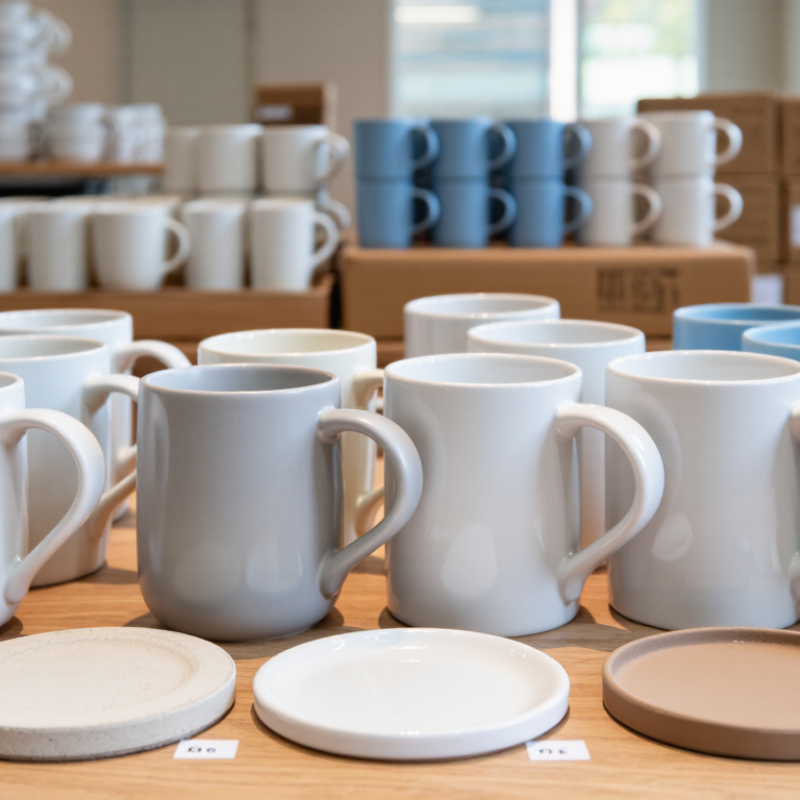
When sourcing bulk ceramic mugs, lock the specification before comparing supplier prices. Capacity should be measured after firing, not from the mold drawing. A “12-ounce” mug may hold 340 milliliters when filled to the rim, but only 300 milliliters safely. Define usable capacity, rim diameter, height, handle clearance, and weight tolerance. A practical tolerance is ±5%, though cheaper production may exceed it. That needs discussion.
MOQ should match your sales forecast and storage space. A 2024 Grand View Research report estimates the global tableware market at approximately USD 45 billion, with continued growth through 2030. This supports strong demand, but it does not justify accepting excessive inventory. Ask for a pilot order, production lead time, defect allowance, and replacement policy. Ten thousand mugs can become expensive if cartons occupy an entire warehouse.
Glaze selection affects appearance, durability, and testing. Request fired color samples, gloss targets, pinhole limits, and confirmation that food-contact materials meet applicable requirements. Packaging needs more than a carton count. Specify dividers, corner protection, drop-test expectations, carton weight, and pallet layout. ASTM C373 measures water absorption and bulk density. Ask the supplier to test fired samples, retain the report, and identify the laboratory. Low absorption is useful, but it does not prove impact resistance. I once treated a polished glaze as a durability guarantee; that was a poor assumption. Test handles, rims, thermal cycling, and packed cartons before approving mass production.
How to Source Bulk Ceramic Mugs from Reliable Suppliers?
Reference planning benchmarks for mug capacity, order quantity, and packaging
The chart uses common commercial mug capacities and indicative bulk-order planning quantities. Actual MOQ depends on decoration, glaze, tooling, packaging, and production capacity. Confirm glaze safety, packaging performance, and water absorption through supplier documentation and ASTM C373 testing before approval.
Screen Suppliers Using ISO 9001, SMETA, and Production-Capacity Evidence
Sourcing bulk ceramic mugs starts with evidence, not polished quotations. During supplier reviews, I request a current ISO 9001 certificate. It should show the legal entity, factory address, scope, and expiry date. The certification body must be independently verifiable. I also compare documented procedures with production records. Can operators trace a mug from clay preparation to final inspection? If not, the certificate may be decorative paperwork. Keep this question visible.
SMETA can reveal labor, health, safety, and environmental management risks. However, it is not a product-quality certificate. Request the latest audit report, corrective-action plan, and closure evidence. Check whether the audit covers the actual mug factory, not an office or trading address. During a video call, ask managers to show attendance records, emergency exits, kiln ventilation, and worker training logs. Details matter. Hidden findings deserve slower approval.
Production capacity needs measurable proof. Ask for kiln volume, firing cycles, molding lines, glaze capacity, shift staffing, and recent output for similar mugs. Compare those figures with your order quantity and delivery window. Request a pilot order before scaling. Inspect rim thickness, handle joints, glaze consistency, carton protection, and breakage rates. I once trusted a capacity estimate too quickly. The first shipment exposed bottlenecks in drying and packing. That mistake changed my process. Supplier claims should match samples, records, and a realistic schedule.
How to Source Bulk Ceramic Mugs from Reliable Suppliers? - Screen Suppliers Using ISO 9001, SMETA, and Production-Capacity Evidence
Anonymous supplier-screening dataset for bulk ceramic mug procurement
| Anonymous Supplier Record |
ISO 9001 Evidence |
SMETA Evidence |
Production-Capacity Evidence |
Quality Performance Evidence |
Commercial and Supply Terms |
Risk Assessment |
Screening Score |
Recommended Action |
| Supplier Record 01 |
Certificate scope includes ceramic tableware manufacturing.
Certificate status: valid.
Last surveillance audit: 7 months ago.
Certificate holder, scope, and validity independently verified with the certification body.
|
SMETA 4-Pillar audit completed 5 months ago.
No critical findings reported.
Corrective-action plan closed for minor working-hours observations.
|
Declared monthly mug capacity: 480,000 pieces.
Verified kiln schedule and three-month production records support approximately 410,000 pieces per month.
Stated standard lead time: 35–45 days.
|
Pre-shipment AQL plan: 1.5 for major defects and 2.5 for minor defects.
Recorded first-pass yield: 97.8%.
Mug handle-strength and thermal-shock test records available.
|
Sample approval required before mass production.
Production deposit: 30%.
Balance linked to inspection approval.
Export packing includes five-layer corrugated cartons and dividers.
|
Low to Moderate |
91 / 100 |
Advance to factory audit and pilot order |
| Supplier Record 02 |
ISO 9001 certificate presented.
Scope covers tableware production but excludes the proposed decoration process.
Validity confirmed; scope gap requires process clarification.
|
SMETA 2-Pillar audit completed 11 months ago.
No critical findings reported.
Overtime documentation requires a current follow-up review.
|
Declared monthly mug capacity: 300,000 pieces.
Verified average output: 265,000 pieces per month over the last three months.
Stated standard lead time: 45–55 days.
|
Recorded first-pass yield: 95.9%.
Glaze pinholes and rim-finish defects account for most rejects.
Corrective-action records available for the previous two production lots.
|
Minimum order quantity: 10,000 pieces per design.
Capacity reservation required during peak season.
Packaging test passed a basic carton drop test; pallet-load test still pending.
|
Moderate |
78 / 100 |
Request updated SMETA review and decoration-scope evidence |
| Supplier Record 03 |
ISO 9001 certificate copy supplied without a verifiable certificate number.
Certification body accreditation could not be confirmed.
Quality manual is available but does not replace independent certification evidence.
|
SMETA self-assessment supplied; no independent audit report provided.
Worker-hours, wage, and grievance records not independently verified.
|
Declared monthly mug capacity: 650,000 pieces.
Only one month of production records supplied.
Kiln loading, firing-cycle, and subcontracting evidence incomplete.
|
No consistent AQL inspection records supplied.
Sample batch showed visible glaze variation and six chipped rims in 200 pieces.
Product testing laboratory information not provided.
|
Quoted lead time: 25–30 days, but capacity evidence is insufficient.
Payment requested in full before production.
No documented replacement or claim procedure.
|
High |
42 / 100 |
Do not approve until evidence and controls are independently verified |
| Supplier Record 04 |
ISO 9001 certificate valid and independently verified.
Scope covers ceramic mug production, glazing, inspection, and packing.
Internal nonconformity and corrective-action logs available for review.
|
SMETA 4-Pillar audit completed 3 months ago.
No critical findings reported.
Two minor findings remain open with documented closure dates.
|
Declared monthly mug capacity: 220,000 pieces.
Verified average output: 205,000 pieces per month.
Stated standard lead time: 40–50 days.
Backup kiln capacity documented.
|
Recorded first-pass yield: 98.4%.
Third-party test reports cover lead and cadmium migration for the supplied glaze system.
Lot traceability links raw material, kiln batch, and packing records.
|
Minimum order quantity: 5,000 pieces per color.
Inspection hold point before final balance payment.
Export cartons tested for compression and vibration resistance.
|
Low |
94 / 100 |
Preferred candidate for pilot and repeat orders |
| Supplier Record 05 |
ISO 9001 certificate expired 2 months ago.
Renewal audit reportedly scheduled but no renewed certificate supplied.
Current process-control records are incomplete.
|
SMETA 2-Pillar audit completed 18 months ago.
Follow-up evidence for previous overtime observations is missing.
No current 4-Pillar assessment available.
|
Declared monthly mug capacity: 380,000 pieces.
Verified average output: 330,000 pieces per month.
Peak-season lead time may extend to 70 days.
|
Recorded first-pass yield: 94.7%.
Inconsistent glaze-color control between lots.
Inspection reports are available for only two of the last six shipments.
|
Competitive pricing but no fixed capacity reservation.
Payment terms: 40% deposit and 60% before shipment.
Packaging specification is not signed off.
|
Moderate to High |
61 / 100 |
Hold approval pending ISO renewal and corrective-action evidence |
Approve Samples with ISO 2859-1 AQL 1.5 and Drop-Test Criteria
Sourcing bulk ceramic mugs begins with a controlled approval process, not a polished catalog photo. I ask suppliers for production samples from the intended clay body, glaze, handle design, and packaging. Each sample receives an internal code. I record dimensions, capacity, weight, color, rim finish, and visible defects. Small details matter. A sharp rim can become a customer complaint.
For mass production, I define ISO 2859-1 sampling before placing the order. The lot size determines the code letter and sample quantity. With AQL 1.5, acceptance and rejection numbers come from the agreed sampling table, not personal judgment. I classify critical, major, and minor defects in writing. A cracked mug is normally unacceptable. Pinholes, surface spots, or slight color variation require agreed limits. AQL 1.5 is a statistical acceptance limit, not permission to ship 1.5% defective mugs. Inspectors should select cartons randomly, rather than choosing convenient pieces. Photos, defect counts, and carton numbers make the result auditable.
Drop testing should match real handling conditions. I test packed cartons from the agreed height, often on a hard floor, across edges, corners, and faces. Afterward, I inspect broken handles, hairline cracks, glaze chips, and shifted protective inserts. Pass criteria must state the sample quantity and allowable damage. One overlooked issue is moisture. A damp carton can soften and change results. I have also seen a perfect sample fail because inner dividers shifted during transport. That mistake deserves review. Approve only when both the mug and its packaging survive repeatable checks.
Secure Contracts with Incoterms 2020, Inspections, and Claims Terms
When sourcing bulk ceramic mugs, a dependable supplier must prove more than production capacity. Ask for factory records, recent export experience, and consistent sample results. I have learned that a polished sample can hide weak carton protection. The purchase contract should describe mug capacity, dimensions, weight, glaze color, handle strength, logo placement, and packaging structure. Attach approved photos and a signed sample reference. Small details prevent expensive arguments later.
Incoterms 2020 should appear with the named place, not as unexplained shipping shorthand. For container cargo, FCA may fit better than FOB because risk can transfer before port loading. If using CIF, define the destination port and required insurance level clearly. State who arranges freight, customs documents, unloading, and local delivery. Risk transfer is not the same as ownership transfer. This distinction is often missed.
Inspections need measurable standards. A third-party inspector can check random cartons before shipment, including glaze defects, cracks, handle alignment, dimensions, barcode labels, and drop-test results. Define acceptable quality limits and inspection timing in the contract. Claims terms should cover notice deadlines, photo evidence, independent reports, replacement units, refunds, and freight responsibility. A practical clause might allow claims within seven days after delivery, while hidden defects receive a longer period. My early contracts used vague words like “good quality.” That was a mistake. A perfect contract cannot prevent every crack, but clear evidence and fair remedies make disputes manageable.